
Last updated November 18, 2026







Free written scope consultation - allowances, timeline, and change-order rules on paper before a single trade is scheduled
Construction Warning Signs: A Denton Homeowner’s Reference Guide
A diagonal hairline crack at the corner of a window frame looks like a cosmetic quirk. In Denton, it often isn’t. The expansive clay soil under much of this city swells when it’s wet and shrinks when it dries, and that cycle pushes and pulls on foundations in ways that telegraph through drywall long before anything dramatic happens. Most homeowners read these symptoms as settling, paint failure, or just an old house being old. The expensive ones are the ones nobody watched. This guide teaches you to read your home the way a contractor does: which cracks matter, what your attic is telling you, how your doors and windows report on your walls, and how to sort the “monitor it” findings from the “call someone this week” findings.
Quick Answer
Construction warning signs in a Denton home are usually early symptoms rather than failures: stair-step cracks in brick, doors that suddenly stick, dark rings on attic roof decking, standing water against the foundation, and gaps where interior trim meets the wall. Categorize each one by cause and rate of change. Cosmetic cracks that stay put can be monitored with dated photos; anything that’s widening, anything that repeats in a pattern, and anything involving water against the structure needs a contractor’s eyes soon.
Styles & brands we work with
- Kitchen remodeling
- Bathroom remodeling
- Home additions & ADU
- Roofing
- Windows & doors
- Driveway & pavers
- Fence
Table of Contents
- Foundation Warning Signs in Denton’s Clay Soil
- Roof Warning Signs You’ll See From Inside First
- The Attic Inspection Checklist
- Drainage Warning Signs Around Hardscape and Landscaping
- Framing and Structural Clues in Interior Finishes
- The Triage Framework: Call Now, Call Soon, or Monitor
- How to Document Warning Signs Properly
- Common Mistakes to Avoid
Foundation Warning Signs in Denton’s Clay Soil
Foundation movement in Denton rarely announces itself with a single dramatic event. It shows up as a pattern. The Blackland Prairie clay that underlies much of the city holds water, expands, and then shrinks hard during dry stretches, and foundations feel every bit of that movement. Your job as a homeowner is not to diagnose the cause. It’s to notice whether the symptoms are consistent with normal, seasonal settlement or with active, uneven movement that deserves a professional look.
Here’s how to tell the two apart by symptom pattern:
- Cosmetic settlement: short vertical or diagonal cracks at interior wall corners, hairline width, present for years, not growing when you compare photos months apart.
- Active movement: stair-step cracks in brick or block, cracks wider than a hairline, cracks you can fit a coin edge into, doors or windows that have stopped latching within the past year, and cracks that appear on both the inside and outside of the same wall.
- Differential movement: one side of the house showing cracks while the other stays clean, a floor that feels noticeably out of level in one room, or a gap that opens and closes with the seasons rather than staying put.
That last pattern is the one to photograph with a date. Seasonal opening and closing can be normal on expansive clay. A gap that never closes back, or one that grows larger each season instead of returning, is a different conversation.
One detail homeowners often miss: the exterior brick is your best early warning system. On a Denton home with brick veneer, walk the perimeter once a season and look specifically for cracks that follow the mortar joints in a stair-step pattern rather than cutting straight through a brick. Stair-stepping suggests movement the veneer is absorbing. It’s not proof of a structural problem, but it’s the finding most worth documenting and mentioning to a contractor.
Roof Warning Signs You’ll See From Inside First
The most useful roof inspection a Denton homeowner can do doesn’t happen on the roof. It happens in the attic and on the ceilings below it. By the time a roof problem is obvious from the street, water has usually been finding its way in for a while. Roofing is a system, and the shingles are only the outermost layer of it.
Watch for these interior symptoms, in rough order of how early they typically show:
- Faint, ring-shaped stains on ceiling drywall, especially near exterior walls or under valleys.
- Brown or gray discoloration on the roof decking visible from inside the attic, which usually traces back to a failing flashing detail rather than the shingle field.
- Daylight showing through the roof boards, which points to missing or damaged material above.
- Paint or texture bubbling or flaking on a ceiling, which often means moisture is behind it.
- Granules collecting in gutters or at the base of downspouts, which signals shingle wear.
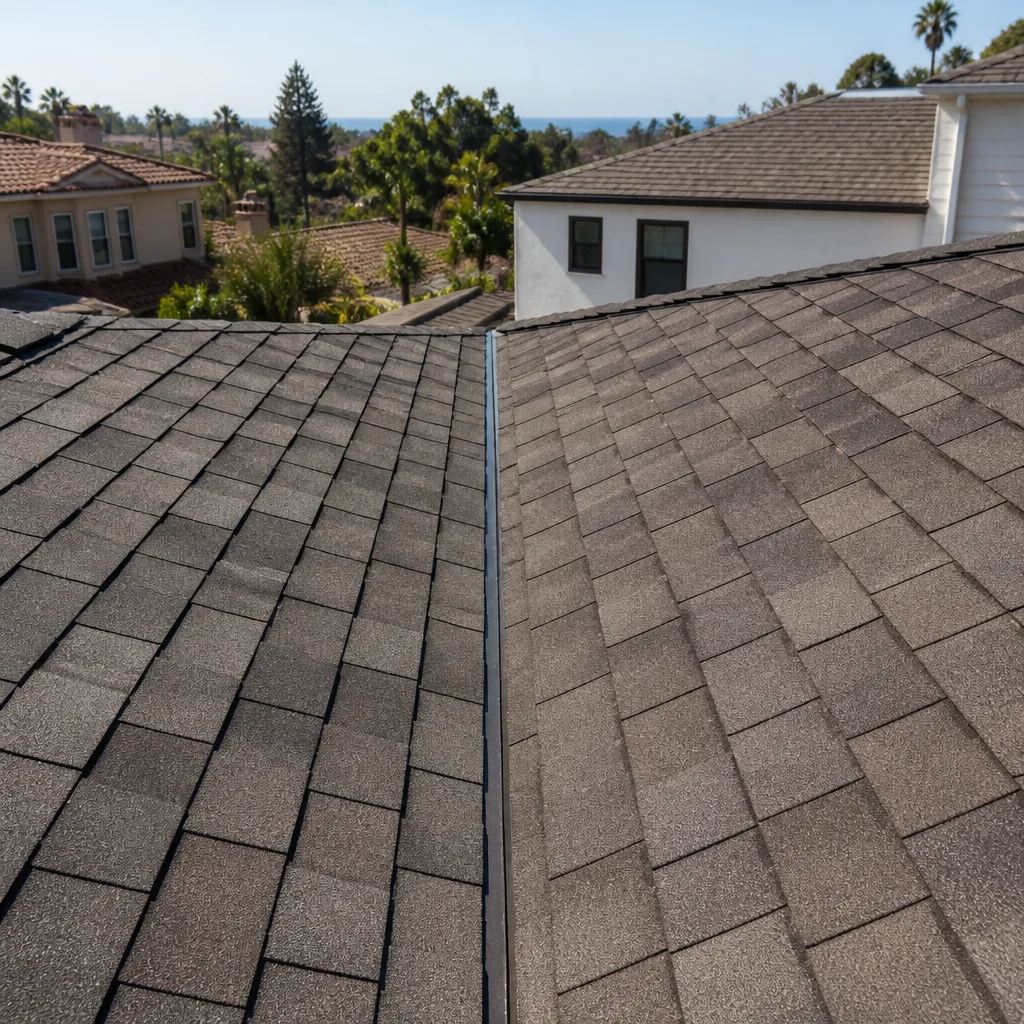
On the exterior, the warning signs worth knowing are lifted or curling shingle edges, missing tabs after a wind event, dark streaks that don’t wash off, and any area where the roof plane looks wavy rather than flat. Flashing at chimneys, vent pipes, and wall intersections deserves the closest look because that’s where most leaks start, regardless of which shingle system is on the roof. If you’re already planning to address roofing, it’s worth knowing how that work pairs with the rest of your exterior envelope, which is the kind of sequencing a single company covering multiple trades can handle. You can see how we approach that on our Construction Denton page.
The Attic Inspection Checklist
Ten minutes in the attic twice a year catches more roof and moisture problems than a decade of looking at shingles from the driveway. Do this in daylight, with a flashlight, wearing a mask, and stay on the walkway or joists. Here’s the sequence:
- Look up at the decking. Scan the underside of the roof boards for dark rings, staining, or soft spots. Water stains concentrate near penetrations and valleys.
- Check for daylight. Turn off your flashlight and look for pinholes of daylight through the roof. Any light that isn’t a vent is a gap.
- Inspect the insulation. Look for compressed, matted, or darkened insulation. Dark, damp insulation is a moisture flag.
- Look for rust. Rusty nail tips poking through the decking mean condensation has been sitting there.
- Smell the air. A musty or earthy smell in the attic is a moisture problem, not a “house smell.”
- Find the vents. Confirm ridge vents, soffit vents, and any exhaust runs are clear and actually connected to the outside, not venting into the attic.
- Trace the flashing. Locate the chimney and pipe penetrations and look underneath for any staining.
- Photograph everything. Interior photos let a contractor see what you saw without a second trip.
Write the date on every photo. Comparing attic photos from two seasons apart gives you a rate of change, and rate of change is what separates a small issue from an urgent one.
Drainage Warning Signs Around Hardscape and Landscaping
Water is the most patient construction problem there is. It never fails to find the low point, and on Denton lots it often finds it against a foundation wall or under a driveway slab. The warning signs are all at ground level, which means they’re easy to see if you know what you’re looking at.
Walk your property after a heavy rain and watch for:
- Standing water against the foundation that lasts more than a day.
- A visible slope that pitches toward the house instead of away from it. A building’s grade should carry water off the structure; if yours doesn’t, that’s the first thing to fix.
- Settled or dipped areas in a concrete driveway, or cracks that run the width of the slab and open noticeably.
- Paver fields where individual units have started to heave, sink, or rock when you walk on them.
- Mulch beds washing out, which is a sign that the grade no longer carries water where it used to.
- Gutter downspouts that discharge right at the foundation instead of routing water away.
Driveway and hardscape failures almost always trace back to water management, not to the material itself. That’s why serious driveway & pavers work starts with grading and base prep before anything goes on top. If your drainage concerns run toward a fence line holding water or a fence footer that’s starting to lean, that’s also a sign of grade and soil movement, and it’s worth folding into fence installation planning rather than patching a post in isolation.
Framing and Structural Clues in Interior Finishes
Your interior finishes are a diagnostic tool you already have. Doors, windows, drywall, and trim all sit on framing, and when the framing moves or a wall shifts, these surfaces report it before anything else does.
Here’s what door and window operation tells you:
- A door that suddenly sticks at the top or bottom suggests the wall it hangs in is moving, not the door itself.
- A door that swings open or shut on its own indicates the frame is no longer plumb.
- Windows that crank hard or won’t latch suggest the opening has racked.
- Diagonal cracks radiating from window or door corners are the classic “wall is moving” call sign.
- Gaps between baseboard and floor, or between trim and wall are usually the first visible sign of movement at floor level.
Interior door sticking is normal in a wet season and annoying in a dry one if your home sits on expansive soil. The distinction is whether doors return to normal when soil moisture normalizes. If they get progressively harder to close and never recover, treat it as active movement rather than a nuisance.
For window replacement specifically, a home that has existing movement also has a decision to make about what kind of windows go back in. That decision is easier when your contractor can talk material and performance at the same table as the structural conversation. Our work in home additions & ADU planning tends to start with the same question: is the structure sound enough to build onto, and if not, what needs to be stabilized first before anything else gets drawn?
The Triage Framework: Call Now, Call Soon, or Monitor
Not every warning sign deserves the same response. Here’s how we sort them, in three tiers:
Tier 1 – Call a contractor now.
- Active water intrusion into the home.
- Cracks you can fit a coin edge into, especially stair-step cracks in brick.
- Any ceiling that sags or shows a bulge.
- A foundation wall that’s visibly bowing or leaning.
- A door or window that has stopped functioning in the last few weeks with no obvious cause.
Tier 2 – Call soon, meaning weeks to a couple months.
- Attic staining that you’ve confirmed is not actively wet.
- A grading issue that pools against the foundation after rain.
- Multiple interior cracks appearing in one wall within a year.
- Any paver or concrete surface that has heaved or sunk by more than a fraction of an inch.
- Flashing details that look attached but haven’t been inspected in years.
Tier 3 – Monitor, with photos and dates.
- Hairline cosmetic cracks in drywall.
- Trim gaps that haven’t changed.
- A sticking door in a wet season that recovers in a dry one.
- Fading or worn shingle surfaces that haven’t produced any interior signs.
The rule underneath all three tiers: rate of change outweighs size. A wide crack that’s been the same for a decade is a smaller problem than a narrow one that doubled in six months.
How to Document Warning Signs Properly
Contractors see a lot of “there’s a crack in my wall” calls. What turns that into a useful appointment is documentation. Here’s the routine that actually helps:
- Photograph each finding with something for scale in the frame, like a coin or a tape measure.
- Note the date, the room, and the exact location on the wall or ceiling.
- Take the same photo again every two to three months.
- Keep a simple running note: any door or window that has started functioning differently, with the date you noticed.
- Photograph the exterior perimeter once per season.
- Save the photos in one folder so a contractor can see the full sequence, not scattered shots.
If you’re considering a major project in the next year or two, this documentation habit feeds directly into good planning. It’s the difference between a scope that addresses what the house is actually doing and a scope that guesses.
Common Mistakes to Avoid
- Painting over a crack before you document it. That hairline crack tells you where movement is happening; covering it erases the evidence before anyone can read it.
- Treating all cracks as “normal settling.” Some are. Stair-step cracks in brick and cracks that repeat in a pattern on the same wall are not the cosmetic kind.
- Assuming the roof is the problem when the ceiling stains. Many ceiling leaks trace to flashing around a chimney or vent pipe, not the shingle field. Replacing the roof doesn’t always fix a flashing leak.
- Burying downspouts or extending them into a bed that holds water. Routing water away from the house is the point; moving it to a different wet spot doesn’t count.
- Ignoring drainage when you’re planning a hardscape project. A new driveway or patio is only as good as the grading under it. Water that pools against the house after the job is the homeowner’s problem, not the slab’s.
- Calling a contractor for a cosmetic concern while ignoring an active one. One sticking door is a nuisance. Two sticking doors plus a hairline crack that’s grown since spring is worth a proper look.
- Having three different trades look at three different symptoms. Foundation, drainage, and roofing issues interact in Denton homes more than people expect, and coordinating specialists yourself often means each one solves only their slice.
See the difference
 Before
 After
 Before
 After
 Before
 After
When to Call a Professional
Call a professional when any of these are true for your home in Denton: a crack has widened since you last looked, a door or window has stopped working in the last few weeks, you’ve seen water staining on a ceiling or in the attic, water pools against the foundation after a heavy rain, a driveway or paver surface has heaved or dipped noticeably, or a wall or trim has started to visibly distort. None of those are emergency calls. All of them deserve a proper look on a schedule you control, not the schedule a spreading problem picks for you.
Construction Denton offers free estimates in Denton, and we can work with the vetted local professionals who handle the actual work. Because we cover seven core services from the driveway to the roofline, one appointment can gather the whole picture instead of handing you three separate reports to reconcile. Our technicians have up to 9 years of experience with the kinds of failure patterns Denton homes produce, whether that’s clay movement under a slab, drainage against a hardscape, or attic moisture from a flashing detail that needs attention. Call (855) 720-1779 to schedule your free estimate. We answer 24/7. Fast dispatch from 7am to 7pm, Sunday through Friday.
Frequently Asked Questions

Stair-step cracks in exterior brick and doors that have started sticking are the two most common early indicators of foundation movement in Denton. Both trace back to the expansive clay soil this area is known for, and both are worth documenting with dated photos so you can see whether the symptom is stable or growing. Call (855) 720-1779 for an exact quote if either one has changed in the last few months; estimates are free.
There’s no fixed timeline, but slow, cosmetic-looking cracks that stay put are a much smaller concern than cracks that change within a single season. The useful metric is rate of change: photograph a crack every two to three months and compare. A crack that has visibly widened over six months is the kind worth bringing to a contractor sooner rather than later. Call (855) 720-1779 to talk through what you’ve documented.
Often yes, especially when the leak traces to flashing around a chimney, vent pipe, or wall intersection rather than to the shingle field itself. The right call depends on what the attic tells you and on how much of the roof material is actually compromised. A contractor can usually tell you in one visit whether a targeted repair will hold. Call (855) 720-1779 to schedule your free estimate.
Your price is set by the written estimate. The point of getting a proper inspection and a line-item quote before work begins is to lock the scope and the number, so a straightforward repair doesn’t grow into something else mid-job. That’s especially true when multiple trades are involved, because the estimate has to account for what each one will actually find in the wall or under the slab. Call (855) 720-1779 for a written quote; estimates are free.
Most structural repairs and any roofing work that changes the building envelope require a permit in Denton, and the specific requirement depends on the scope. The right move is to ask your contractor whether the work needs a permit and to ask the city’s permit office to confirm before work starts. We can work with the local pro handling your job to make sure permits are pulled and inspected where required. Call (855) 720-1779 to get the conversation started.
Cosmetic cracks are typically short, hairline width, and stable over months. Structural indicators include stair-step patterns in brick or block, cracks wider than a hairline, cracks that repeat on the inside and outside of the same wall, and any crack paired with a door or window that has stopped operating normally. When in doubt, document both sides of the wall with dated photos and get a professional opinion. Call (855) 720-1779 and we’ll help you sort what you’re seeing.
The estimate is free, and the price of any actual work is set per job by the written estimate. Your appointment is for someone to look at what you’ve found, tell you what it means, and put the scope in writing, which is the useful part. Call (855) 720-1779 to schedule yours. We answer 24/7. Fast dispatch from 7am to 7pm, Sunday through Friday. We are closed on Saturday.
The Bottom Line
Construction warning signs in a Denton home are usually not the failure. They’re the message the failure is sending, and the earlier you read it the cheaper the conversation becomes. Foundations on expansive clay telegraph through brick and interior finishes. Roofs telegraph through the attic. Water telegraphs through grading and anywhere it pools. Doors and windows telegraph wall movement every time you open them. If you take one thing from this guide, take the triage habit: photograph what you see, note the date, watch for rate of change, and call a contractor when something is widening, active, or interacting with water. Not every sign needs a call, but the ones that do tend to get cheaper the sooner the call happens.
Contact
If you’ve spotted a warning sign in your Denton home and want a professional opinion before it becomes a bigger project, call Construction Denton at (855) 720-1779 for a free estimate. We can work with the vetted local professionals across every trade, from the driveway and fence line to the roofline, so one visit can give you a full picture. We answer 24/7. Fast dispatch from 7am to 7pm, Sunday through Friday. We are closed on Saturday.
Written by the team at Construction Denton.