Last updated November 18, 2026


Free written scope consultation - allowances, timeline, and change-order rules on paper before a single trade is scheduled
The Complete Driveway & Pavers Guide for Denton Homeowners
Most homeowners think the pavers are the project. They’re not. The pavers are the visible finish on top of a system that decides whether your driveway still drains in five years, whether the edges stay put, and whether you’re looking at heaves and dips after a couple of Texas summers. The base, the grading, and the edge restraint do the actual work, and they’re all buried by the time you see the finished surface. In this guide we’ll walk you through how a driveway and paver project really comes together in Denton: the base layers that matter, the brands worth asking about, the costs you can expect, the mistakes that cost the most to fix, and how our local climate and clay soil change the plan. Consider it your working reference before you sign anything.
Quick Answer
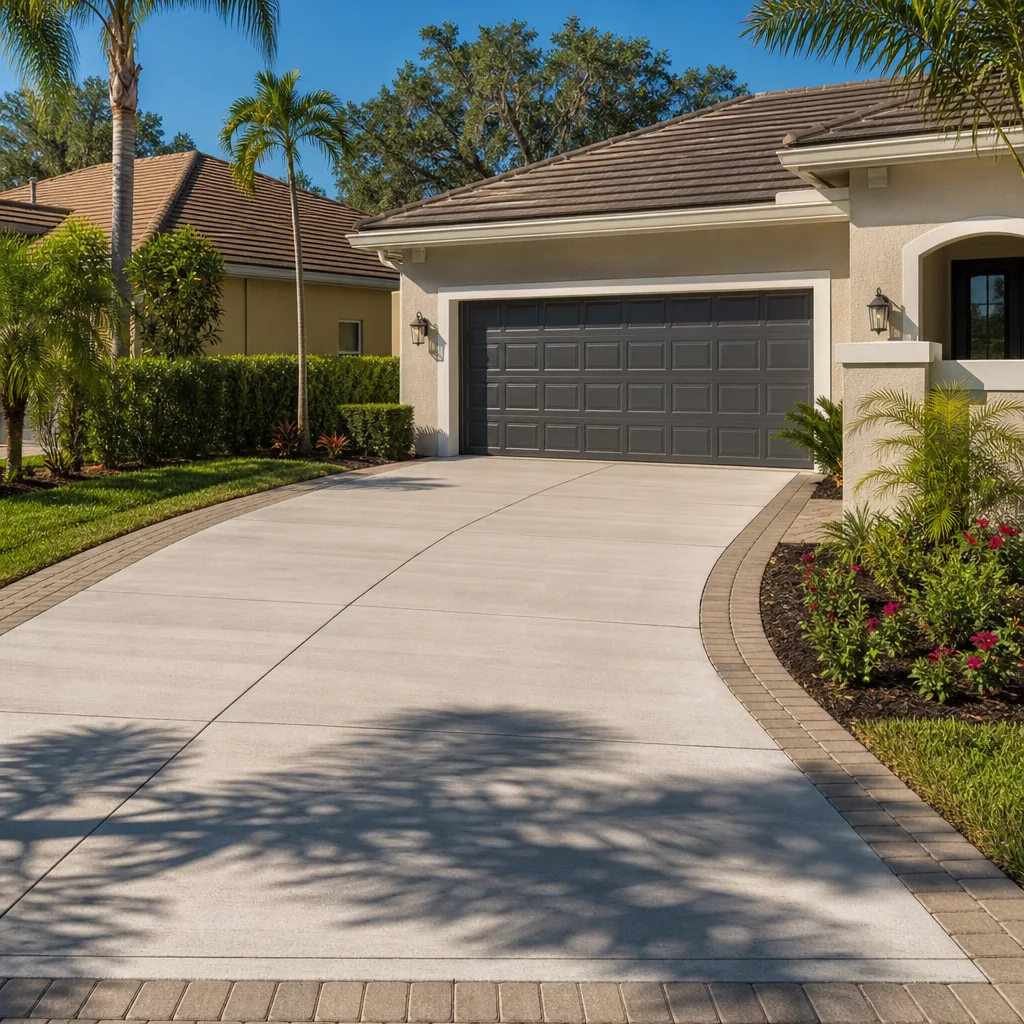
A paver driveway in Denton is a layered system, not a single surface: an excavated subgrade, a compacted crushed-stone base, a bedding layer, and the pavers themselves, held at the edges by a restraint that keeps the whole field locked together. Concrete pavers from brands like Belgard, Techo-Bloc, Unilock, and Tremron are the material most homeowners choose for driveways because they handle vehicle loads and can be lifted and reset if something underneath shifts. A properly built paver drive in Denton typically costs more than poured concrete up front, lasts longer with less patching, and is the only hardscape you can repair without tearing out the whole thing.
Styles & brands we work with
- Kitchen remodeling
- Bathroom remodeling
- Home additions & ADU
- Roofing
- Windows & doors
- Driveway & pavers
- Fence
Table of Contents
- Why the Base Matters More Than the Pavers
- How a Paver Driveway Is Built, Step by Step
- Choosing Paver Materials for a Denton Driveway
- What a Driveway Costs in Denton
- Drainage, Clay Soil, and the Denton Climate
- Driveways, Patios, and Walkways: Same Rules, Different Loads
- Pavers vs. Concrete vs. Asphalt in Denton
- Keeping a Paver Drive in Shape
Why the Base Matters More Than the Pavers
The single most common problem we see on failed paver jobs is a base that was too thin, made of the wrong material, or never compacted in proper lifts. A paver is a durable block. It’ll sit there for decades. But it sits on whatever’s beneath it, and in Denton that “whatever” is often expansive clay that swells when it gets wet and shrinks when it dries. If the base isn’t engineered to bridge that movement, the surface telegraphs every bit of it back up to you as dips, heaves, and joints that open up.
A proper base does three jobs at once:
- Spreads the load. A vehicle’s weight doesn’t land on one paver. It transfers down through the surface into the base and the subgrade below. Too thin a base and the load concentrates, which is where rutting starts.
- Isolates movement. A graded, compacted crushed-stone base acts as a buffer against the swell-shrink cycle of clay. It gives the pavers a stable platform that moves far less than the soil under it.
- Manages water. The base and the slope work together to move water off the surface and away from the house. Get the grade wrong and no paver, no matter how premium, will keep your drive dry.
This is why we’re material-fluent about the brands you see on top, and just as particular about what’s underneath. Belgard, Unilock, Techo-Bloc, and Tremron all make commercial-grade paver systems used on both residential and commercial jobs, and they hold up when the base is right. None of them can rescue a base that’s wrong. When someone quotes you a paver driveway, the question to ask isn’t just “which paver?” It’s “how deep is the base, and how is it compacted?”
How a Paver Driveway Is Built, Step by Step
Here’s the sequence a well-run paver driveway follows in Denton, in order. It’s worth knowing because it tells you what to watch for during the build and what a low bid is likely skipping.
- Assess the subgrade and plan drainage. We look at the existing soil, the slope of the drive, and where water needs to go (away from the foundation, toward the street or a drain). The finish grade is set before a shovel goes in.
- Excavate to depth. The excavation has to account for the base depth, bedding layer, and paver thickness together, not just the pavers. Cut it shallow and you’ll lose base. Cut it deep and you’ll need more stone.
- Install and compact the base in lifts. Crushed stone goes in layers, each compacted before the next goes down. You can’t compact a foot of stone in one pass and get uniform density. Proper lifts are what make the base perform.
- Set the edge restraint. The edge is what keeps the field from spreading under load. A paver drive with a weak or missing edge will creep outward over time, joints open, and the pattern loosens.
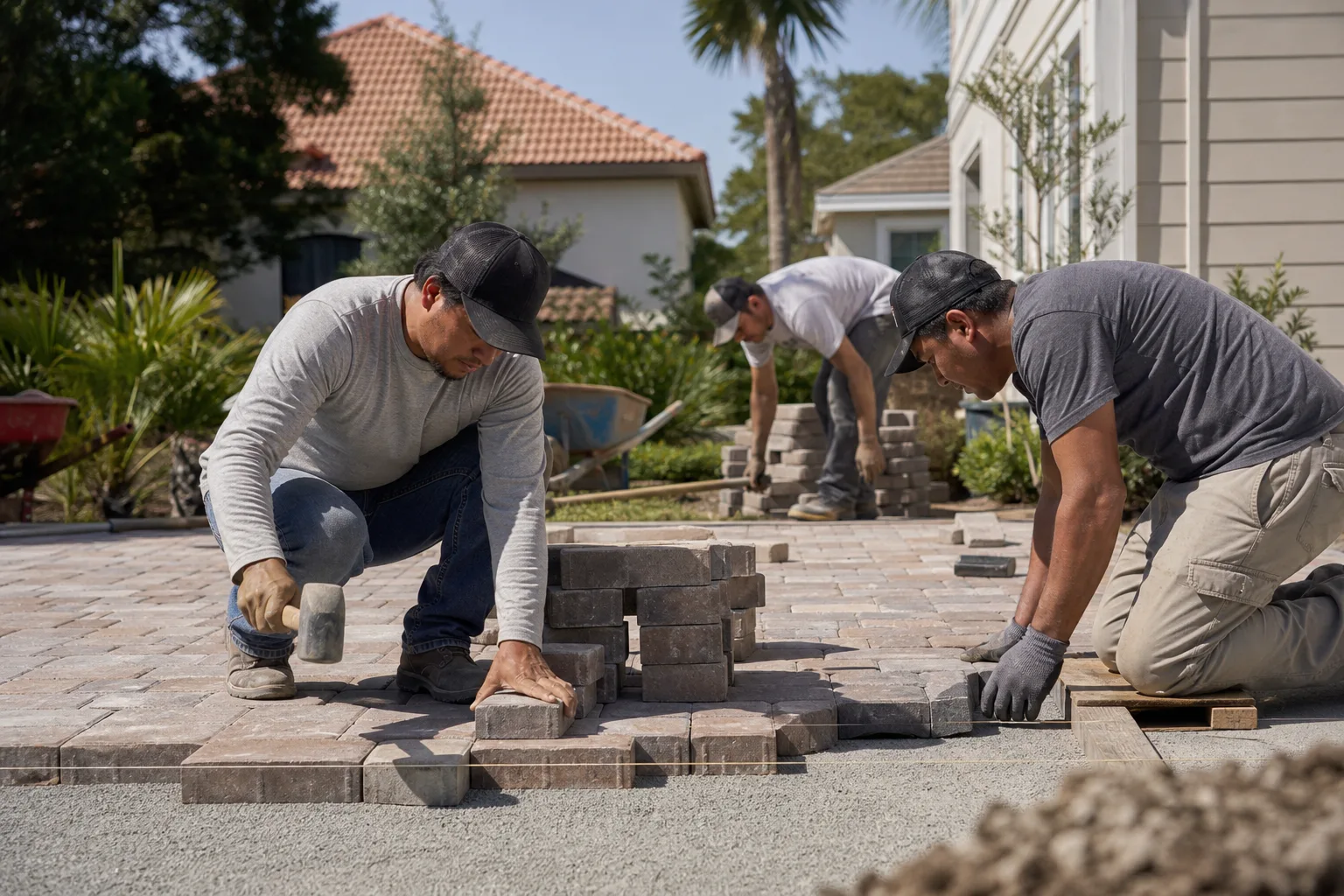
- Lay the bedding layer and set the pavers. A thin, screeded sand layer lets the pavers seat evenly. The pattern is laid to the plan and cut at the edges for a clean line.
- Compact the surface and fill the joints. A plate compactor seats the pavers into the bedding, and joint sand is swept in and worked into the gaps. Some systems use polymeric sand, which locks the joints and resists washout.
- Clean and final check. The surface is cleaned, the grade is confirmed, and any cuts or transitions at the garage apron and street are finished.
That’s the whole job in outline. The time it takes depends on square footage, access, and how much site prep the subgrade needs. A typical driveway is a multi-day project, not a one-afternoon install, and a contractor who treats it like one is cutting somewhere. For a closer look at how this plays out on our side of the work, see driveway & pavers.
Choosing Paver Materials for a Denton Driveway
The pavers themselves are where homeowners get the most choices and, often, the most confusion. The material choice affects how the drive looks, how it handles traffic, and how well it holds up to the north Texas sun and the occasional hard rain. Here’s how the options break down.
Concrete pavers
The standard for residential driveways. Concrete pavers from Belgard, Techo-Bloc, Unilock, and Tremron come in a range of shapes, colors, and finishes, and they handle vehicle loads well when the base is right. They’re the most common choice for a reason: durable, repairable, and available at accessible-to-premium price points within the category.
Clay brick pavers
Clay pavers offer a classic look and hold color well over time. They’re a genuine option, but they need to be laid on a properly built base just like concrete pavers, and the upfront cost tends to run higher. Color-fastness is the appeal; the installation discipline required is the same.
Permeable pavers and joint systems
Permeable paver systems are designed to let water move through the surface and into the base rather than run off. Where a driveway has drainage challenges or you want to manage stormwater on-site, this is worth discussing. It’s a system decision, not just a paver swap: the base and joints are part of the design.
What to ask about
- What paver line is being quoted, and is it a commercial-grade system or a lighter residential line?
- What’s the base depth for this driveway, and why?
- What edge restraint is being used?
- Sand joints or polymeric joints, and why?
We’re material-first on purpose. You choose the finish, we handle the base, the grade, and the sequencing so the pavers you picked perform the way the manufacturer engineered them to. The same rigor applies whether the pavers are going on a driveway, a patio, or a front walk.
What a Driveway Costs in Denton
A paver driveway in Denton typically runs higher than poured concrete up front, and the estimate depends on square footage, base depth, paver line, edge conditions, and how much site prep the subgrade needs. Below are typical ranges by project type to help you budget. These are estimates, and the written estimate sets the final price.
| Project | Typical Range (Estimate) | What Drives the Number |
|---|---|---|
| Paver driveway, standard size | Higher upfront than poured concrete | Square footage, base depth, paver line |
| Paver patio | Moderate | Size, pattern complexity, edge and drainage |
| Paver walkway | Lower end | Length, width, cuts and transitions |
| Base repair / reset on existing pavers | Varies widely | How much of the field needs lifting |
Why we don’t quote a flat per-square-foot price here: the same paver over a thin base versus a properly engineered base are two different jobs with two different costs, and the cheap one isn’t cheaper in the long run. If a quote is dramatically below the others, ask what got cut. Usually it’s base depth, compaction, or the edge restraint. Those are the three things that fail first.
The good news is that the material tier is yours to set. Premium lines like Belgard and Techo-Bloc are available, and there are accessible tiers within every category too. You don’t have to choose between a brand-backed paver and a budget. You choose the finish you want, and we build the system underneath it. For an exact number on your driveway, Construction Denton offers a free estimate with a written, line-item quote. Call (855) 720-1779. We answer 24/7, with fast dispatch from 7am to 7pm, Sunday through Friday.
Drainage, Clay Soil, and the Denton Climate
Denton sits on expansive clay soil, and that one fact reshapes almost every hardscape decision. Clay holds water, expands when it’s wet, and shrinks as it dries. A paver driveway built without accounting for that movement will find out about it. The base has to bridge the movement, and the drainage plan has to move water off the surface fast, before it can soak into the subgrade and start the swell cycle.
What a proper drainage plan covers:
- Surface slope. The finished surface has to shed water toward a planned exit, away from the house and toward the street, a swale, or a drain. A flat-seeming drive that pools after rain is a grading problem.
- Water at the edges. Water running along the sides of a drive can undermine the base if it isn’t directed. Edge restraint and proper grading work together here.
- Downspout and roof runoff. If roof water dumps onto or near the driveway, the drainage plan has to account for it. Redirecting a downspout or adding a drain can be part of the job.
- Where the water goes after it leaves the drive. It has to go somewhere that doesn’t create a new problem for you or a neighbor.
The Denton summers are also hard on surfaces. Intense sun and heat play across a paver field all season, and a drive that isn’t built to move slightly with temperature changes will show stress at the joints. The climate doesn’t demand exotic materials. It demands a system built to move where it should and stay put where it shouldn’t. That’s a base-and-grade decision more than a paver decision.
Driveways, Patios, and Walkways: Same Rules, Different Loads
A patio and a driveway are built from the same principles, but they aren’t built the same, because they carry different loads. A driveway takes vehicle weight, which is far heavier and more concentrated than foot traffic. A patio takes people, furniture, and the occasional grill. The base depth, compaction, and edge requirements scale with the load.
What stays constant across all three:
- Excavate to the right depth for the base the load requires.
- Compact the base in lifts, not in one thick pass.
- Set the edge restraint so the field can’t spread.
- Plan the drainage for the surface you’re building.
- Choose a commercial-grade paver line for the job’s exposure, not just its look.
The differences are in the numbers: base depth, compaction passes, edge design, and how the pattern is laid. A backyard patio in Denton behind a house can be more forgiving on drainage fall than a driveway that meets a sloping street. A front walkway has more cuts and transitions because it meets steps, plantings, and the house. All of it is one project in the hands of one contractor, which is a real benefit when you’re doing a front-yard and backyard hardscape at the same time and don’t want two crews tripping over each other.
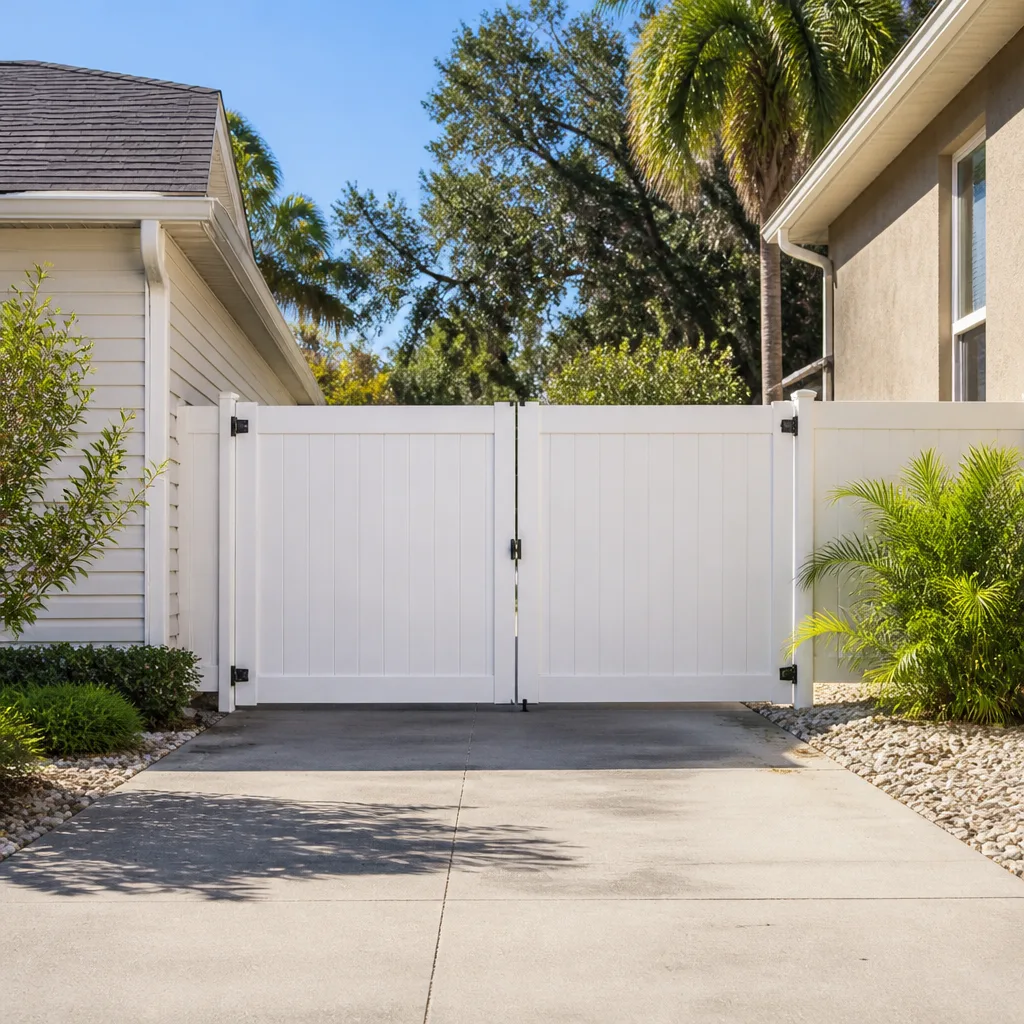
Hardscape and softscape work best planned together. If your driveway project overlaps with fencing or a new patio layout, that’s a good moment to talk sequencing, and we can fold fence installation into the same plan so the yard comes together as one project instead of three separate ones.
Pavers vs. Concrete vs. Asphalt in Denton
All three get a car off the street and into the garage. The differences show up over time and on the day something needs repair.
- Pavers: Higher upfront cost. The advantage is that a paver drive is a system you can repair locally: lift the affected pavers, fix the base, reset them. No tearing out the whole slab. Over a decade or two, that repairability is where the value compounds, and the finished look holds up under the sun.
- Concrete: Lower upfront cost, and it makes a clean, flat surface. The tradeoff is that concrete is monolithic: when it cracks or a section settles, you’re patching, cutting, or replacing a chunk. Stamped concrete can approximate a paver look, but it isn’t a paver system, and it doesn’t come apart for repair.
- Asphalt: The lowest upfront cost and a smooth drive. It needs maintenance over its life and patching when it fails. It has its place on a budget, but it doesn’t offer the paver system’s repairability or finish variety.
The honest framing is that pavers are a spend more now, repair less later decision. If you’re staying in the house, the value shows up over years. If you’re weighing it against concrete and the budget is the deciding factor, a conversation about paver tiers is worth having. There are accessible-to-premium options within the category, and you can get a brand-backed paver at a tier that fits, not just the top of the range.
Keeping a Paver Drive in Shape
A well-built paver driveway asks for very little, but it does ask for some attention. Here’s what keeps one looking and performing well in Denton:
- Replenish joint sand as it settles. Over time, joint sand works down and can wash with heavy rain. Refilling it keeps the surface locked and helps stop individual pavers from shifting.
- Keep the edges intact. The edge restraint is the backbone of the field. If you see soil washing out at the driveway edge, address it before it undermines the base.
- Watch drainage. Water pooling in one spot tells you the grade has moved. Catching it early is far cheaper than letting the base soften underneath.
- Clean with care. A light wash and a stiff broom handle most of it. High-pressure washing on a paver surface can strip joint sand and disrupt the bedding, so go easy on the pressure.
- Weed the joints. Occasional weeds take root in the joint line. Pull them while they’re small rather than waiting for a clump.
None of this is complicated, and most of it is visual: look at the surface, look at the edges, and see how water behaves after a hard rain. If something’s off, a small fix now is cheaper than the base repair it becomes later.
Common Mistakes to Avoid
- Skipping the base depth to save money. The most common failure starts here. A shallow base saves a few dollars on the quote and costs far more when the drive ruts and dips. Ask what depth your base is being built to and why.
- Compacting the base in one pass. Stone has to go down in lifts and be compacted layer by layer. One thick pass leaves soft pockets the surface will telegraph. It’s invisible until it isn’t.
- Ignoring the edge restraint. A missing or weak edge lets the field creep and the joints open under load. This is one of those hidden parts that decides whether the drive stays tight.
- Getting the grading wrong. A drive that pools in Denton’s clay soil is asking for trouble. The surface has to slope toward a planned exit, away from the house, before anything is laid.
- Choosing pavers on color alone. A premium paver on a thin base is still a failed driveway. Match the paver line to the load and the exposure, then pick the color.
- Skipping the drainage conversation. Roof runoff, downspouts, and site slope all affect the drive. A plan that ignores them builds in a future problem.
- Hiring on price alone. The lowest bid is often the base that got cut. Compare base depth, compaction plan, edge design, and paver line before you compare numbers.
See the difference
 Before
 After
 Before
 After
 Before
 After
When to Call a Professional
Some paver issues are preventive maintenance and some are a sign the base has given up. Call a professional when pavers are visibly rutting or sinking, when the surface pools after rain, when joints open in a pattern, when the edges are washing out, or when a section of an existing paver drive has heaved and won’t reset. Those are drainage and base problems, not paver problems, and they need the system underneath fixed. A reset without base repair just delays the next failure. If you’re planning a new driveway or patio and want the base, grade, and drainage built right the first time, that’s the right moment for a conversation too. Construction Denton offers free estimates in Denton. Call (855) 720-1779. We answer 24/7, with fast dispatch from 7am to 7pm, Sunday through Friday.
Frequently Asked Questions
A paver driveway in Denton typically costs more upfront than poured concrete, and the estimate depends on square footage, base depth, paver line, and site prep. Paver patios and walkways sit at different price points than a full drive. These are estimates, and the written estimate sets the final price. Call (855) 720-1779 for an exact quote – estimates are free.
A typical paver driveway is a multi-day project, not a one-afternoon install, because the base has to be excavated, compacted in lifts, and set before the pavers go down. Time depends on square footage, subgrade conditions, and access. Anyone promising a finished drive in a single short visit is skipping steps. Call (855) 720-1779 to schedule your free estimate and a realistic timeline.
Yes, when the base is engineered for it. Denton’s expansive clay soil and hot summers demand a properly compacted base and a drainage plan that moves water off the surface. The paver line matters, but the base and grading decide how the drive performs over time. Commercial-grade systems from brands like Belgard, Techo-Bloc, Unilock, and Tremron are built for that kind of exposure.
Often, yes. One of the real advantages of pavers is that a single section can be lifted, the base under it repaired, and the pavers reset, without tearing out the whole drive. How much of the drive needs to come up depends on how far the problem has spread. That’s something to assess in person before committing to a scope.
The written estimate sets your price, and the scope should account for what the base and grade require so there aren’t surprises. If we find something unanticipated under the surface, we discuss it with you before any extra work happens. Fixed pricing with no change orders is the goal on every job. Call (855) 720-1779 to start with a free estimate.
Most cities require a permit for work that changes grade, drainage, or the frontage of a property, so the right answer is to check with the city’s building department for your specific project. We can tell you what’s typically required and handle the permitting process on the jobs we take on, and inspections are part of the plan. Call (855) 720-1779 to talk through your project.
The Bottom Line
A driveway or paver project in Denton succeeds or fails on the parts you can’t see: the base, the compaction, the edge restraint, and the drainage plan. The pavers are the finish, and brand matters, but brands like Belgard, Techo-Bloc, Unilock, and Tremron are only as good as the system underneath them. Compare quotes on base depth and build sequence, not just the surface. Plan the grade and drainage for clay soil upfront. And when you’re ready to price the job, get a written, line-item estimate with fixed pricing and no change orders. Construction Denton handles driveway and paver work from the first excavation to the final pass, and we can pull in home additions & ADU and other exterior projects on the same property when the timing lines up. Start with a free estimate: call (855) 720-1779. We answer 24/7, with fast dispatch from 7am to 7pm, Sunday through Friday.
Written by the team at Construction Denton.